Showing posts with label India. Show all posts

Tuesday, 22 August 2017

Royal Scots Fusiliers - name those soldiers!


I bought this photo last week and now I'm trying to put names to the faces.

There are eight men: seven colour sergeants with the regimental sergeant major seated in the centre. The men all belong to the Royal Scots Fusiliers and they're all wearing khaki. Oddly, with so many years' service between them, there's not a single medal ribbon to be seen.

This leads me to surmise whether these men belonged to the 1st Battalion, Royal Scots Fusiliers. The 1st Battalion had last earned campaign medals for the Crimea in 1855. They had been stationed in the UK since 1882 but in 1896 they sailed for India, arriving in September. They would remain in India until 1910 when they embarked for South Africa.

In this photograph, the men wear the 1896 pattern frock; the Indian version with the scalloped collars. Could this photograph have been taken shortly after their arrival in Sialkot?  In 1897 the battalion would take part in the Tirah campaign and those men who participated would later be awarded medals.  

The senior NCOs listed below all received the India Medal with clasps for Punjab Frontier 1897-98 and Tirah 1897-98 (and Colour-Sergeant Smith also received the clasp for Samana 1897).  Do any of these men appear in my photo above?

1448 RSM F W Lees
541 William John Bailey
2331 Col Sgt James Craig
1164 Col Sgt William Smith
2026 Col Sgt J Walker

Judging by their regimental numbers, William Bailey would have joined the regiment in 1883, Lees and Smith in 1885, Walker in 1887, and Craig in 1888. None of these men went on to serve in South Africa during the Boer War and all would have been time-expired by 1914 (although William Bailey re-enlisted in 1915 aged 52!)

Of course, the men in the photo could also have belonged to the 1st Battalion, RSF which would go on to see service in South Africa between 1899 and 1902. Known senior NCOs of the 1st Battalion in 1901 are listed below:

RSM J H Steele
289 Col Sgt G Manley
958 Col Sgt R Taylor
1375 Col Sgt J Forrest
1481 Col Sgt A Ferguson
1558 Col Sgt A Angus
1647 Col Sgt J Young
1701 Col Sgt W Kimberley
1789 Col Sgt W Lodge
2512 Col Sgt J Allchin
2772 Col Sgt R Smith
4425 Col Sgt W Brettargh

If anyone can assist with the identity of these men - or even confirm the battalion, I'd be very pleased to hear from you. Leave a comment or drop me a line via the Research tab.


Sunday, 2 April 2017

6477 Rfm Samuel Morter Smith, Rifle Brigade


Here's a great photograph of a boxing and wrestling champion who served with the Rifle Brigade between February 1899 and November 1911. The write-up that accompanies this photograph in the Rifle Brigade Chronicle for 1908 notes that Samuel was born on the 13th March 1881 and served with the 4th Battalion Mounted Infantry during the Boer War. He was later posted to the 2nd Battalion in India and won several boxing and wrestling tournaments. The final paragraph of the shirt editorial reads:

"He frequently displays feats of strength, both in the barrack room and on the stage of entertainments, one of which is to make a bridge of himself, and in this position supporting seven men (equivalent to 1,087 lbs). He is entirely self trained and is popularly known as "Sandow Smith".

As well as notching up various wins in the ring, Samuel also amassed quite a good collection of tattoos. His original attestation papers survive in WO 97 and the distinctive marks' section on page two simply mentions "scar on left eye-brow" and a "patch of hard skin, back of left hand". 


We can be certain therefore, that all of the tattoos on display here were acquired after he joined the army. The tiger and palm trees on his chest was presumably inked some time after his arrival in India in February 1906.  There is what appears to be rifle on his upper right arm, above the crossed swords motif commonly rendered as a badge for army gymnastics instructors. On his left arm there are two flags, possibly Rifle Brigade standards, and other motifs which are unclear. Who knows what was rendered on his back.

Samuel Smith remained in India until 1911 but returned home in November and was discharged "free after 12 years' service" this, despite having re-engaged at Fort William, Calcutta in February 1911 to complete 21 years.

If he served in the First World War, I have yet to find evidence of this. He certainly worked as a policeman, however, and on the 1939 Register is listed as a retired police constable, married to Rosie L Smith (born 20th July 1894). There are also four probable children noted, as well as three closed records:


When the 1939 Register was taken, Samuel and his family were living at Broad Street, Depwade Rural District, Norfolk. I have not yet identified when and where he died.


Saturday, 1 October 2016

572 Sergeant Richard Gray, Leinster Regiment


Above, unknown sergeant from Richard Gray collection. 

I bought some photos on eBay recently which were from a larger collection of photos that had once belonged to Richard Gray. The vendor of the photographs had broken the collection up and some had already been sold elsewhere. Having been together for well over a hundred years, I always find it deplorable that collections are thus distributed, and so if the buyer of those other photographs should happen to read this, I will be very happy to buy back the missing photos.

The notes which follow are from my research into Richard Gray. Numbers in square brackets refer to the last four digits of his service record which happily survives in series WO 363 (now available on Ancestry and Findmypast). I shall be happy to receive information about this man. 

For help researching your own soldier ancestor, contact me.

23rd September 1865
Born at Aharn, Fermoy, County Cork [2821 & 2829]; son of William Gray of Portlaw, County Waterford
3rd December 1865
Born [1939 Register]
23rd August 1884
Attested, aged 18 years and 11 months [2821], a teacher [2829]
24th August 1884
Birr. Accident off duty. [2826]
27th August 1884
Depot. Joined Leinster Regiment, regimental number 572 [2825]
28th October 1884
Depot. Obtains First Class Certificate of Education [2833]
15th November 1884
Posted to 2nd Battalion [2832]
21st February 1885
2nd Battalion. Appointed lance-corporal [2832]
23rd July 1885
2nd Battalion. Promoted corporal [2832]
19th September 1885
2nd Battalion. Fermoy [2826]
14th December 1885
Posted to 1st Battalion [2832] 
INDIA: 15TH DECEMBER 1885 - 13TH JANUARY 1895
15th December 1885
HMS Malabar [2826]
10th January 1886
Landed in India [2826]
25th January 1886
Faizabad? [2826]
1st May 1886
India? [2826]
8th November 1886
Calcutta [2826]
19th November 1886
Assistant Instructor in Army Signalling [2833]
1889
Silver Medal for Mathematics [2818]
16th March 1890
Transferred to the Unattached List for employment in the Public Works Dept. Promoted Sergeant on the Unattached List [2832]
21st March 1890
Agra [2826]
15th May 1891
Resigns appointment on Bengal Unattached List [2832]
Corporal [2832]
23rd September 1891
Passed fit to extend service to 12 years [2826]
21st May 1892
Passes class of instruction in Divisional Transport [2833]
6th November 1892
Appointed Orderly Room Corporal [2831]
9th December 1892
Dessa? India [2826]
31st December 1892
Appointed Lance-Sergeant [2831]
12th October 1893
Appointed Acting Sergeant [2831]


I believe this photo - not one of those which I purchased - dates to this period

3rd March 1894
Poona  [2826]
Deolali [2826]
HOME - 13TH JANUARY 1895 - 18TH OCTOBER 1900
14th January 1895
Tipperary [2826]
22nd April 1895
Clonmel [2826]
16th September 1895
Tipperary [2826]
11th December 1895
Promoted Sergeant [2831]
27th February 1896
Re-engaged at Navau to complete 21 years [2831]
1st March 1896
Transferred to 5th Battalion [2831]
16th September 1896
Marries Alice Edith Slade at St Mary's Church, Navan [2833]
1st October 1896
Birr [2826]
25th September 1898
Son, William F D Gray born at Navan, Meath [2833 & 1911 Census]
1st March 1899
Posted to Depot [2831]
8th April 1899
Shorncliffe [2826]


I believe this superb photo dates to around this time. All of the men pictured appear to be senior NCOs, mostly from the Royal Artillery.  Richard Gray is standing, third from left. 

5th September 1899
Fermoy [2826]
17th January 1900
Birr [2826]
20th June 1900
Daughter, Alice Edith Gray born at Birr, King's County [2833 & 1911 Census]
24th August 1900
Sentenced by DCM to be reduced to the ranks for drunkenness on duty [2831]
25th August 1900
Reduced to Private [2831]
SOUTH AFRICA - 19TH OCTOBER 1900 - 20TH SEPTEMBER 1902
19th October 1900
Transferred to 1st Battalion [2831]
20th September 1902
S S Englishman [2826]
1st September 1902
Appointed paid Lance-corporal [2831]
HOME - 21ST SEPTEMBER 1902 - 22ND AUGUST 1905
28th October 1902
Fermoy [2826]
18th July 1903
Son, Richard Bruce Gray born at Fermoy [2833 & 1911 Census]
1st March 1904
Obtained Acting Schoolmaster certificate [2833]
18th June 1904
Shorncliffe [2826]
30th October 1904
Promoted corporal [2828 & 2831]
22nd August 1905
Corporal Richard Gray. Discharged at Shorncliffe, aged 39 years and 11 months, on the termination of second period of limited engagement [2818]. Intended place of residence is Military Avenue, Cheriton, Kent [2833]
1908
Son, Thomas Alexander Gray born at St-Peter's-in-the-, Kent [1911 Census]
1910
Daughter, Eleanor Dorothy Gray born at Chelsfield, Kent [1911 Census]
April 1911
Recorded as "Army Pensioner - Schoolmaster. Not employed" Living at Ivy Dene, Green Street Green, Orpington, Kent [1911 Census]


Detail from a larger photograph - not mine - which may date to around this time.

11th August 1914
Attests for General Service at Maidstone with Royal West Kent Regiment, aged 48 years and 9 months; a teacher. Posted to regimental depot, regimental number G/659 [2835]
11th September 1914
Attestation date incorrectly noted [2821]
12th September 1914
Promoted sergeant [2821]
23rd October 1914
Posted to 9th Battalion, RWK [2836]
30th August 1915
France [2837]
22nd September 1917
Transferred to Labour Corps, sergeant [2836] Reg No: 378453 [2837]
19th December 1918
Discharged [2821] no longer physically fit for war service [2836]. Address, Ivy Dene, Green Street, Orpington, Kent [2836]

This photo - not mine -must pre-date the award of Richard's First World War medals. The cap and collar number suggest an omnibus or tram company but I would welcome further thought on this.

29th September 1939
County Hospital, Farnborough, Orpington. "Incapacitated. Retired civil servant. Army Pensioner. Wife Alice is also a patient  [1939 Register]
23rd January 1940
Died, County Hospital, Farnborough, Orpington, aged 74. Address given as Ivy Dene, Worlds End Lane, Chelsfield, Orpington. Death registered by son, Richard B Gray, of Southlands, 148 Park Avenue, Orpington [2822]


Sunday, 17 January 2016

10th Hussars & Major Roland Pillinger

Here's a good site to visit, for anyone with an interest in the 10th Hussars or Queen Victoria's Army generally.


Born in 1860, Major Roland Pillinger joined the 10th Hussars as a private in 1879 and was commissioned twenty years later. This website charts his military career and includes hundreds of original photographs. It is, quite simply, a treasure trove. In my opinion, highlights of this website are the photos taken at Rawal-Pindi in 1910 (including the photo above) as well as the albums of X Hussars photographs covering the years 1879-1886. There are also previously unseen photos of the 1911 Delhi Durbar.


Sunday, 11 January 2015

The secret wife of Edwin Mole aged 35


I've just finished reading "The King's Hussar" by Edwin Mole; a very readable and fascinating account of a cavalryman's lot during the latter half of the nineteenth century. Mole is a good research candidate because of his relatively unusual name and, furthermore, he has surviving service papers in WO 97 which, for the most part, tie in perfectly with his narrative.


Edwin Mole seems, from his own account, to be a reasonable man. He received a Long Service and Good Conduct Medal in 1888 and his narrative contains fascinating insights into army life. I was particularly interested in his account of his time in Bangalore in India, a city I also lived in for a number of years.

He was obviously very fond of his first wife who died during childbirth in India in 1878 but he makes no mention at all of his second wife, Agnes Manley Morton, whom he married in 1881. She was a good deal younger than Edwin but, for whatever reason, does not warrant a single mention (whereas his house-boy, Harry, rescued from the side of the road, gets many glowing and affectionate references).

It would appear from surviving paperwork which picks up where his army narrative leaves off, that Edwin Mole had a somewhat troubled later life which included spells in various asylums. He married for a third time in May 1891 (although note that the census taken a month earlier, records Edwin and Fanny Mole as husband and wife). Fanny was 18 when he married her, although her age is over-stated as 26 on the 1891 census return.

Edwin Mole lived to a ripe old age, dying on 3rd August 1937 aged 90. He left his estate to the surviving daughter from his first marriage. Details from his long life, gathered from a variety of sources, are noted below.

I thoroughly recommend this memoir (easily available on Amazon) which, in many ways, reminded me of Frank Richards' Old Soldier Sahib and the British Army in India a couple of decades after Edwin Mole left the country.

Edwin Mole's army papers survive in WO 97 and can be accessed online through Findmypast.


1847
Born. “My father [John Mole] was formerly a small farmer at Dudley in Worcestershire, but in 1852, when I was about seven years old, he left the country and came up to London…” He was probably born in 1847 according to subsequent census returns
1851 [1851 census return, 26 Cross Street, Dudley, Worcs]
Three year old son of John Mole, 28-year-old baker, and Sarah Mole, 30-year-old domestic. Also a sister, Annie Maria aged 1.
1861 [1861 census return, 7 Rose Gardens, Hammersmith]
13-year-old son of John Mole, 39-year-old labourer, and Sarah Mole, 40-year-old laundress. Edwin is a butcher, 11-year-old Annie Maria, 9-year-old Moses, 7-year-old Simeon, 3-year-old Sarah Jane.
27th July 1865 [Service record, WO 97]
Home. Attests aged 18 years
5th-6th Nov 1866 [Service record, WO 97]
Imprisoned
1st-2nd March 1866 [Service record, WO 97]
Imprisoned
31st July 1868 [Service record, WO 97]
Good Conduct Pay at 1d
31st July 1871 [Service record, WO 97]
Good Conduct Pay at 2d
8th November 1871 [Service record, WO 97]
2nd Class Certificate of Education
12th October 1872 [Service record, WO 97]
Promoted Corporal
18th March 1874 [Service record, WO 97]
Promoted Sergeant
1875 [Irish Marriages – FamilySearch]
Marriage to Margaret McAvoy in Dublin North
4th January 1876 [Service record, WO 97]
India
1st April 1876 [Service record, WO 97]
Commenced Deferred Pay
29th December 1876 [British in India baptism record]
Daughter, May Elizabeth Mole, born
1st February 1877 [British in India baptism record]
Baptism of daughter May Elizabeth Mole at Holy Trinity Church, Bangalore
[May Mole later married Horace William Pettman in 1905. Appears on 1911 census with husband (aged 32) two sons, George Horace Pettman (1907-1986) aged 4 and Margaret Mary Pettman (1910-1992), aged 8 months. Husband, Horace W Pettman died in 1914. Re-married Martin R Dunn in 1918. May Elizabeth Dunn, nee Mole, died 1960 in Bromley. Daughter married Charles R Gaunt 1931. ]
31st July 1877 [Service record, WO 97]
Good Conduct Pay at 3d
1st-4th October 1878 [Service record, WO 97]
Tried and reduced [to] Private. Sentence remitted.
5th October 1878 [Service record, WO 97]
Sergeant
Forfeited 1d GC Pay
14th October 1878 [Service record, WO 97]
Birth of second daughter. “Ten days after my court martial my wife presented me with another little daughter…” [Page 161]
14th October 1878 [British in India burial record]
Death of first wife, Margaret Mole, aged 25 years and 4 months, from acute mania, Bangalore.
15th October 1878 [British in India burial record]
Burial of Margaret Mole at Bangalore Trinity Church
October 1878 [The King's Hussar, Page 162]
Death of new-born daughter “… the infant following its mother very soon afterwards, I sent my little daughter home to England, where I knew she would be happy and well cared for with her aunt…” [Daughter’s birth and death not found in British in India records.]
5th October 1879 [Service record, WO 97]
Restored 3d Good Conduct Pay
26th June 1880 [Service record, WO 97]
Appointed Troop Sergeant Major
27th January 1881 [Service record, WO 97]
Marriage to Agnes Manley Morton [aged 20, daughter of Edward Evans Morton], Trinity Church, Bangalore. [Agnes born 24 Dec 1860 at Black Town, Kamptee, daughter of Inspector Edward Morton and Emma Rosa Morton. Died Edmonton, Middlesex in 1937]
26th February 1881 [Service record, WO 97]
South Africa
1st December 1881 [Service record, WO 97]
India
1883 [Service record, WO 97]
Musketry, Secunderabad
3rd January 1884 [Service record, WO 97]
Home
31st July 1886 [Service record, WO 97]
Entitled to 4d Good Conduct Pay
1st September 1886 [Service record, WO 97]
Transferred Suffolk Yeomanry – Permanent Staff
13th September 1886 [Service record, WO 97]
Permitted to extend his service beyond 21 years
3rd February 1888 [The Ipswich Journal, British Newspaper Archive]
Henry Manby of Church Farm, Burgh, summoned by Edwin Mole, sergeant major of the Ipswich troop of the Loyal Suffolk Hussars for not paying 26s. fine… Bench orders payment of fine and 10s. costs.
17th May 1888 [Service record, WO 97]
Awarded LSGC with gratuity
1st July 1888 – 24th July 1888 [Service record, WO 97]
Further service
5th April 1891 [1891 census, Liberal Club, Wiltshire]
Aged 42, club steward. Husband of Fanny [Luxton] Dean, aged 26. George Dean, a 16-year-old billiard marker, and 49-year-old Harry Stevens, a widowed cloth worker, are also at the same address. Note that Edwin and Fanny did not actually marry until the following month.
17th May 1891 [LMA records]
Marriage to Fanny Luxton Dean, aged 18. Fanny’s birth registered 4th quarter 1872 at Dartford. Died 1947, Kensington, London.
16th September 1893 [Bedfordshire Times and Independent]
Review of the recently published, “A King’s Hussar”.
30th December 1893 [Leicester Chronicle]
Review of the recently published, “A King’s Hussar”.
4th January 1894 [York Herald, British Newspaper Archive]
Review of the recently published, “A King’s Hussar”.
20th January 1894 [Sheffield Evening Telegraph, British Newspaper Archive]
Extensive and positive review of the recently published, “A King’s Hussar”.
22nd January 1894 [Birmingham Post, British Newspaper Archive]
Review of the recently published, “A King’s Hussar”.
24th January 1894 [Derby Mercury, British Newspaper Archive]
Review of the recently published, “A King’s Hussar”.
27th January 1894 [Manchester Courier and Lancashire General Advertiser, British Newpaper Archive]
Review of the recently published, “A King’s Hussar”.
1901 [1901 census. Cold Storage, Purfleet Wharf, St Ann, Blackfriars]
Aged 53. Clerk and caretaker; also Fanny Mole aged 28, housekeeper, born Swanley, Kent.
18th January 1904 [Baptisms, St Mary’s, Spital Square, Middlesex]
Birth of daughter, Minnie Ellaline Mole.
1905 [Electoral Register]
9 Norton Folgate, dwelling house, Whitechapel, Tower Hamlets
31st August 1908 [UK lunacy patients, admission registers]
Admitted to Napsby Asylum
21st November 1908 [UK lunacy patients, admission registers]
Discharged from Napsby Asylum
24th August 1910 [UK lunacy patients, admission registers]
Admitted to Essex Asylum
9th December 1910 [UK lunacy patients, admission registers]
Discharged from Essex Asylum
Admitted to London Asylum
1911 [1911 census return]
Aged 70, married. Patient, City of London Lunatic asylum and Still House; Stone, near Dartford; formerly house decorator
18th December 1913 [UK lunacy patients, admission registers]
Discharged from London Asylum
1915 [Electoral Register]
Dwelling house, Westminster, Marylebone West
8th February 1917 [Central Criminal Court. Calendars of Prisoners]
Edwin Kempson Mole, poultry farmer aged 70, charged with “Marrying Fanny Luxton Dean, his wife being then alive.” Found not guilty and discharged.
3rd August 1937 [National Probate Calendar]
Death of Edwin Kempson Mole “of 175 High Street, Harlesden, Willesden, Middlesex”. Died at “Twyford Lodge, Willesden. Administration London 13th January to May Elizabeth Dunn (wife of Richard Martin Dunn). Effects £410 5s. 6d.”


The original edition of "The King's Hussar", published in 1893, carries a portrait of Edwin Mole, above. The undated photo I have used at the top of this post shows 14th Hussars on the march and probably dates to the early 1900s. 

Do you have an Edwin Mole in your family? I offer a fast and cost-effective military history and British Army research service and would be happy to assist. Click on the Research tab (or this link) to contact me directly.

Monday, 21 January 2013

India 1912 - a hot-weather ballad


In these cold-weather days, here's what an unknown soldier of the 1st HLI, then based in Lucknow, wrote about the soldier's lot in India in 1912

A hot-weather ballad


When the west wind blows scorchin’ and fierce o'er the plains,
When you sit 'neath a punkah and pray for the rains,
When your body is burning with prickly heat,
And insects devour both your ankles and feet-
What a glorious country is India!

When you think of your friends in a healthier land,
Far from the scalding heat, dust-storms, and sand,
While you're sweating and cursing and shouting "Kinsho!"
And wondering whether it's hotter below
What a beautiful country is India!

You have read of the wonderful nights in the East,
Of the moonlight and peace when the day's work has ceased.
Well, this may be all very nice in its way,
But it's not my experience, I'm sorry to say,
Of a hot-weather night here in India.

For you find, when you lay yourself down on your bed,
That the brain-fever bird sends you half off your head,
While the jackal and pie-dog persistently howl,
And the chokidar coughs when he's doin' his prowl.
Oh, the joys and blessings of India!

When you rise in the morning at four forty-five
You're as weak as a rat, and more dead than alive.
And you’re soaked to the skin ere your toilet is done,
Whilst you're dreading the rise of the glorious sun.
Oh, why did I come out to India?

Now, you people at home who complain of the cold,
Don't get huffy and cross when the truth you are told,
For you're far better off than the soldier-man bold
In the plains in the summer in India.

The image on this post has been borrowed from Bharat Rakshak and shows British officers and Sikh soldiers from the 45th Sikhs after the relief of Chakdara Fort in 1897.

Sunday, 6 January 2013

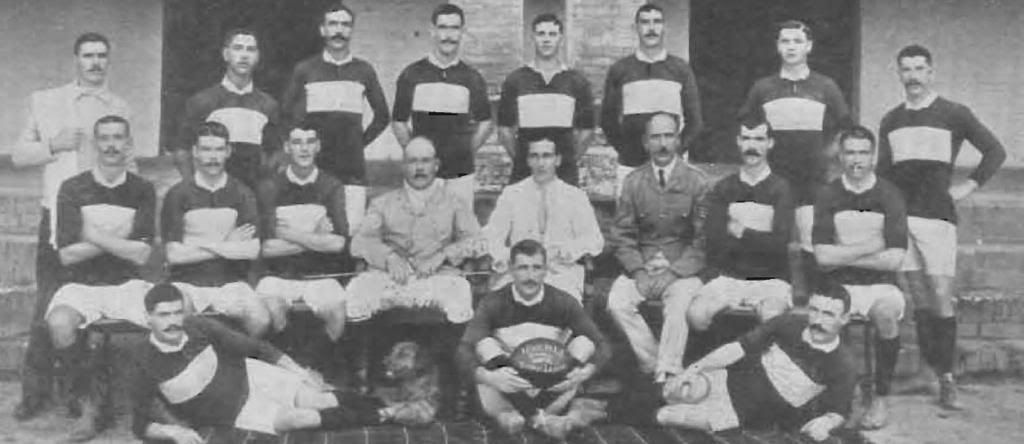
1st Bn HLI - I Coy Football Team - India 1909


Not the best quality photo in the world, but better than nothing I suppose, particularly if your ancestor happens to be one of the men captured above, and listed below:


This photo of the I Company football team was published on page 21 of the January 1910 issue (Volume X, No 1) of the Highland Light Infantry Chronicle, and many of the men pictured here would go on to serve with the Battalion during WW1. I've not researched all of the names here but Lt Alston was Captain Alston by 1915 and was killed in action at Chateau Redoubt near Neuve Chapelle on the 18th August that year. 5337 Col-Sgt Robert Brisbane, a prisoner of war by April 1915, survived the war as Warrant Officer Class II (and with a silver war badge to accompany his QSA, Delhi Durbar Medal 1911 and 1914 Star trio).

The names of the squad are:

Pte Smith, Pte Corrigan, Pte Docherty, Pte Schwerin, Pte McGeechan, Pte Wiseman, L/Cpl Lawson, Pte Passfield, Pte Reddy, L/Cpl Geake, Captain H T C Singleton DSO, Lt R C W Alston, Col-Sgt Brisbane, Pte Metcalfe, Pte Turner, Pte Olden, Pte Henderson, Pte Bruce.

Sunday, 23 September 2012

The British Army & The Indian Railway

A while ago, wearing another hat as a so-called "military expert" for Find My Past, I attempted to answer a query from Jean Field regarding her British Army ancestor who was apparently, at some point in time, serving concurrently with the Indian Railways.  Jean's original query and my response is here, on the Find My Past blog.

Last week, re-reading Old Soldier Sahib by Frank Richards, I came across this passage which explains how the arrangement worked.  Frank was a regular soldier serving in India at the turn of the last century with the 2nd Battalion, Royal Welsh Fusiliers and he later served with distinction throughout World War I, winning the DCM and the MM into the bargain. I wish I'd recalled this passage from Old Soldier Sahib when I originally replied to Jean.

"One railway company invited men of good character to go through a six months' course of railway training. The only men who were eligible for this course were those who had six or twelve months to serve before they became time-expired. If they went through this course they were away from the battalion for six months but drew their ration money and pay; the railway company found them lodgings and also paid them a rupee a day for the duration of the course.  At the end of it they had to pass an examination, but even if they passed it they could still please themselves whether they took a job on the railway or went back to the battalion. If they accepted a job they were transferred to the Army Reserve, in spite of having perhaps six months still to serve before they became time-expired.  They generally began work as passenger guards, and rose from that to something higher."