Showing posts with label Highland Light Infantry. Show all posts

Monday, 21 January 2013

India 1912 - a hot-weather ballad


In these cold-weather days, here's what an unknown soldier of the 1st HLI, then based in Lucknow, wrote about the soldier's lot in India in 1912

A hot-weather ballad


When the west wind blows scorchin’ and fierce o'er the plains,
When you sit 'neath a punkah and pray for the rains,
When your body is burning with prickly heat,
And insects devour both your ankles and feet-
What a glorious country is India!

When you think of your friends in a healthier land,
Far from the scalding heat, dust-storms, and sand,
While you're sweating and cursing and shouting "Kinsho!"
And wondering whether it's hotter below
What a beautiful country is India!

You have read of the wonderful nights in the East,
Of the moonlight and peace when the day's work has ceased.
Well, this may be all very nice in its way,
But it's not my experience, I'm sorry to say,
Of a hot-weather night here in India.

For you find, when you lay yourself down on your bed,
That the brain-fever bird sends you half off your head,
While the jackal and pie-dog persistently howl,
And the chokidar coughs when he's doin' his prowl.
Oh, the joys and blessings of India!

When you rise in the morning at four forty-five
You're as weak as a rat, and more dead than alive.
And you’re soaked to the skin ere your toilet is done,
Whilst you're dreading the rise of the glorious sun.
Oh, why did I come out to India?

Now, you people at home who complain of the cold,
Don't get huffy and cross when the truth you are told,
For you're far better off than the soldier-man bold
In the plains in the summer in India.

The image on this post has been borrowed from Bharat Rakshak and shows British officers and Sikh soldiers from the 45th Sikhs after the relief of Chakdara Fort in 1897.

Sunday, 6 January 2013

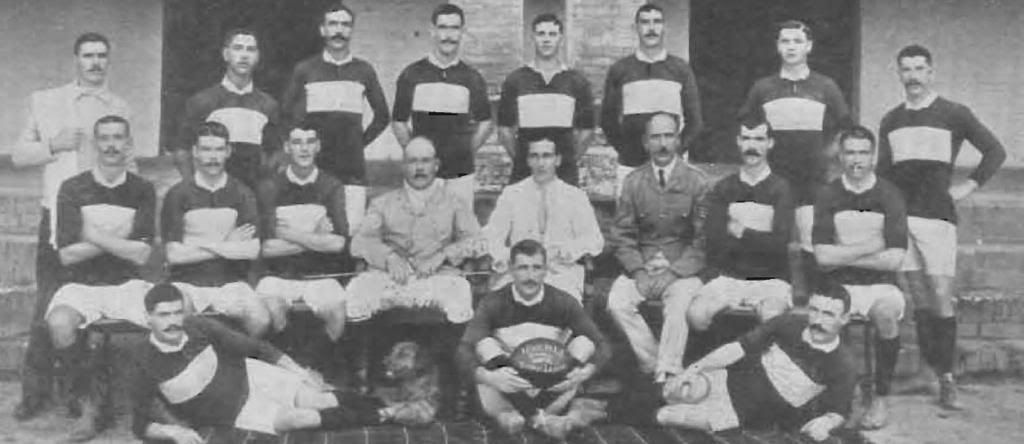
1st Bn HLI - I Coy Football Team - India 1909


Not the best quality photo in the world, but better than nothing I suppose, particularly if your ancestor happens to be one of the men captured above, and listed below:


This photo of the I Company football team was published on page 21 of the January 1910 issue (Volume X, No 1) of the Highland Light Infantry Chronicle, and many of the men pictured here would go on to serve with the Battalion during WW1. I've not researched all of the names here but Lt Alston was Captain Alston by 1915 and was killed in action at Chateau Redoubt near Neuve Chapelle on the 18th August that year. 5337 Col-Sgt Robert Brisbane, a prisoner of war by April 1915, survived the war as Warrant Officer Class II (and with a silver war badge to accompany his QSA, Delhi Durbar Medal 1911 and 1914 Star trio).

The names of the squad are:

Pte Smith, Pte Corrigan, Pte Docherty, Pte Schwerin, Pte McGeechan, Pte Wiseman, L/Cpl Lawson, Pte Passfield, Pte Reddy, L/Cpl Geake, Captain H T C Singleton DSO, Lt R C W Alston, Col-Sgt Brisbane, Pte Metcalfe, Pte Turner, Pte Olden, Pte Henderson, Pte Bruce.

Thursday, 22 December 2011

Royal Cyphers on attestation papers


There is some great artwork on early attestation and discharge papers and here's an example from the discharge papers of 131 Private William Nelson of the 74th Regiment of Foot who left His Majesty's Army on the 31st July 1836 after 24 years and 129 days' service which included "7 years and 5 months in North America [and] one year and 8 months in the West Indies". He was discharged at his own request (and in apparently robust health) signing that:

"I perfectly understand , that in receiving my discharge at my own request, I entirely relinquish all Claim to Pension, and that, even if I should re-enlist, my past Services prior to the date of my present Discharge cannot be allowed to reckoned for the purpose of obtaining any benefit from Chelsea Hospital".

Little wonder that the army often struggled to recruit and was consistently below establishment (despite the relaxing of standards in height, weight and chest expansion) throughout the nineteenth century.  Still, the Royal cypher is excellent.