Showing posts with label Pen & Sword. Show all posts

Friday, 10 January 2020

Rugbeians in the Great War - Review


As author Daniel J McLean points out, "3,252 Rugbeians served in the Great War, of whom 687 were killed. This represents twenty-one per cent of the total, almost twice the national average."

I have a growing interest in public school contributions to the war effort and as far as Rugby School is concerned, I was already very familiar with the seven volumes of "Memorials of Rugbeians who fell in the Great War" which were published between 1916 and 1923. Indeed, most of the men whose portraits feature in those seven volumes also appear on my British Army Ancestors website. The Memorials volumes are extraordinary tributes to those Rugbeians who died in the service of their country during the First World War, and whilst this new volume from Pen & Sword draws on some of these biographies, and uses some of the photos, the scope is far wider and in places much more detailed; putting the service of individual Rugbeians into the context of the war as a whole.

There are helpful appendices and a useful index and bibliography; essentials in my book but sadly often overlooked these days. The author, a former teacher, has obviously also had access to the school archives and there are some, I'm guessing, previously unpublished photos of pupils and staff which add to the book's overall appeal.

Sunday, 27 January 2019

Images of the National Archives Armistice - Review


Louise Bell

Pen & Sword, £14.99


As Louise Bell notes in her introduction to this slim but useful volume, "This book will highlight key documents from the collections at The National Archives relating to the Armistice and the aftermath of the First World War. Many of these images will have been rarely seen and will provide key glimpses into what was happening in 1918 and beyond."

And so they do. This paperback book only runs to 132 pages but there are some extremely useful chapters on treaties, demobilisation, women's uniformed services, disability, Peace Day, The Unknown Warrior and The Cenotaph.

I have to admit to being a bit of a cenotaph nut.I have collected hundreds of postcards of the cenotaph over the years and so learning more about its evolution and the different cenotaph versions worldwide is always going to find a ready audience with me. But I also found the chapter on disability extremely informative and thought-provoking and, since reading this book, I have made my own forays into the LAB (labour) files at The National Archives which Louise Bell references.

I regard this useful book as a platform for further study, and as such I will definitely be returning to it again, and again...

Wednesday, 19 December 2018

The Armistice & The Aftermath - The Story in Art


The Story in Art

John Fairley

Pen & Sword Books Ltd £25

If you're quick enough and follow the link on this page you'll be able to buy this book for £20 rather than the £30 published price. This is a good 'coffee-table' art book and the format of it permits many of the paintings inside to be shown as full-colour portraits that occupy an entire page. 

If I have criticisms, they are that the ordering of the artwork is a little haphazard and I would also have been more inclined to say less about the artwork and let the art itself do the talking, filling those extra pages with more art. Some of the photography could have been better - I'm thinking of the section devoted to Lutyens and his work - and for that matter not all of the paintings in this book would have made it past my selection criteria. Just because a piece of art depicts scenes from, or personalities connected with, the First World War does not automatically make it good art. 

At the end of the day this is an interesting pot pourri that should probably be in every school library and every civic library, assuming that there are any of the latter left.


Shooting the Somme - Review


Bob Carruthers

Pen & Sword Books - £25

Actually, the vast majority of this book is a re-print of Geoffrey H Malins's "How I filmed the War". The only original content here is Section 1 which takes up a mere 44 pages of the 344 page total. So somewhat disappointing that there is so little background to what has become regarded as iconic footage over the years; and of that background there are a number of pages taken up with an overview of the Battle of the Somme itself. 

If you didn't already have a copy of Malin's book then this would be worth buying. Other than that, much of the information contained in section one - and more besides - could almost certainly be gleaned online.

Tuesday, 27 November 2018

The Soldiers' Peace - Book Review


The Soldiers' Peace
Michael Senior
Pen & Sword Books Ltd, £25

Just when you thought that there could not possibly be another book on the Great War that sheds new light on that awful conflict, along comes one that does. The Soldiers' Peace ticks all the boxes for me, every single one of them: 

  • it covers a topic that has not been done to death
  • it is written in an engaging and free-flowing style that is easy to read
  • the events described follow a logical and chronological path
  • there are useful appendices that augment the text that has gone before
  • there are clear footnotes laid out by chapter
  • there is a useful bibliography
  • there is an index
You'd be surprised at how many of what I regard as these basic must-haves are missing from works of historical fact. Not in this book. Michael Senior has researched his topic well and he writes authoritatively about it. It's a fascinating subject too, dealing with the demobilization of the British Army at the end of the First World War. As the dustwrapper informs us, "In November 1918... the British Army numbered 3.75 million. One year later that number was reduced to 890,000." The Soldiers' Peace tells you how that was achieved.

Sunday, 4 November 2018

The Badges of Kitchener's Army - David Bilton


The Badges of Kitchener's Army
David Bilton
Pen & Sword Books Ltd
£30 / $60 US

Just when you thought that after four and a half years of relentless publishing, there couldn't possibly be anything new to be said about the First World War, along comes David Bilton with The Badges of Kitchener's Army. I suspect that this book will quickly become a classic.

I remember correspondence with the author back in the mid-eighties. I had already interviewed a lot of Great War veterans and David was also trying to meet men in order to ask them about the cloth badges they had worn. We exchanged details and I corresponded with men David had met, and he corresponded with men I had met. I remember thinking at the time that he had set himself a difficult task; time was running out and  many of the veterans I had met had already died. Nevertheless, looking at the roll-call of veterans referenced in the book, he obviously spectacularly succeeded.

This is a book that has been many years in the researching and it will be an extremely important reference resource for anyone with an interest in the Great War and in particular those pedantic individuals like me who want to analyse every last pixel of a military photo.

Chapter by chapter the author dissects the Kitchener units, detailing known instances of insignia specific to the unit in question. The book is comprehensively illustrated and the author has referred to multiple reference sources on what has, up until now, been a little-understood topic. In fact he has written THE reference source on this subject and I hope that there will be revised editions in future once additional information has come to light.


This is a book that earns its place next to titles about regiments, uniforms, cap badges and collar badges and mine is already handily within arm's reach. Well done, Dave Bilton, on producing a real cracker - and thanks for the acknowledgement on page 345.


Tuesday, 24 October 2017

Photographing the Fallen: Ivan Bawtree and the GRU


Ivan Bawtree had a very different Great War. Working with the Graves Registration Unit of the Royal Engineers, and calling on his pre-war photographic expertise with Kodak, Ivan photographed the graves and cemeteries of France and Belgium. His work survives today as The Bawtree Collection at the Imperial War Museum, and the photograph that appears above is part of that 600-image collection.

Pen and Sword have just published a book about Ivan Bawtree's work, written by his great nephew, Jeremy Gordon-Smith, and it's a cracking read, packed full of Ivan's photographs and augmented by Ivan's diary entries and Jeremy Gordon-Smith's own research.  For me personally, with a growing interest in the work of the Imperial War Graves Commission and men like Lutyens and Baker whose architectural excellence can be seen in hundreds of cemeteries and memorials in Britain and on the old Western Front, this book adds some incredibly useful information. 

Obviously inheriting some of his great-uncle's photographic skills, there are some cleverly manipulated shots which merge contemporary views with Ivan's original photographs, and there are some great archive images of those early growing cemeteries as well as lighter moments snapped with comrades.

This has to be one of the more profusely illustrated of Pen & Sword's books, published to the usual high standards and including useful notes, a bibliography and index. Better still it is well-written and a fitting tribute to the man behind the lens. If I didn't already have a copy, this would certainly be on my Christmas list. 

Photograph © Jeremy Gordon-Smith. Readers may also be interested to know that Ivan Bawtree's service record survives in WO 363. Clicking on the link will take you to it.

Wednesday, 15 March 2017

Colchester in the Great War - Review


Colchester in The Great War
Pen & Sword Books
£12.99 (or less)

Colchester in the Great War, by local author Andrew Phillips, is certainly one of the better books in this particular Pen & Sword series. For a start, having already published eight books about Colchester and its history, the author knows his stuff and has almost certainly drawn on those earlier accounts in this new publication. He also tells a good story and writes engagingly and informatively about the town. I lived in Colchester for a while and have family who still live there, but the vast majority of what Andrew Phillips writes about was certainly news to me, and fascinating news at that.

Above all though, Mr Phillips never loses sight of the town; how the town was situated before the war, the effect the war had on ordinary lives, and the aftermath. At least 1250 local men died during the conflict and whilst the author pays tribute to them, this book is not essentially about the players but rather the stage from where they sprung, and to where the survivors limped back home afterwards.

As is customary with the books in this series, Colchester in the Great war is well illustrated and even includes a photograph, I was interested to note, that I owned some years ago; a photo of the unveiling of the impressive war memorial outside the equally impressive castle. 

This is a good read and a nice addition to books on Essex generally and Colchester specifically. As a former and current garrison town it is also almost certainly long-overdue.

Sunday, 5 March 2017

Welsh Yeomanry at War


The 24th (Pembroke & Glamorgan) Yeomanry Battalion, Welsh Regiment came into being in February 1917 with the merger of two very distinct Yeomanry regiments, the 1/1st Pembroke (Castlemartin) Yeomanry and the 1/1st Glamorgan Yeomanry. This new title from Pen & Sword Books picks up the story at this point and sheds new light on an aspect of the war - the war in Palestine - that has been largely neglected. Not that the men serving with this regiment did not also get a taste of the horrors of trench warfare either, for that matter; in May 1918 the regiment embarked for France with the rest of the 74th Division and took part in the final 100-day offensive against the German Army.

For anyone with an interest in this particular unit this will be essential reading. There is a roll call of regimental dead, potted biographies of officers, and details of honours and awards. This, in addition to the main narrative, follows the well-worn pattern of regimental histories published in the 1920s and 30s. In addition though, and as exemplified here, today's historian has access to far more resources: newspapers, personal archives, service records published online by Ancestry and Findympast, not to mention the willing assistance of archivists and others. In this particular case that all comes together very well in this long overdue history of the 24th Welsh Regiment.

Cambridgeshire Kitcheners


Joanna Costin is to be congratulated for her labours both in writing this book and also in remembering these same men of the 11th Suffolk Regiment on the Lives of the First World War site. This is another impressive title to add to the unit library built up by Pen & Sword over the years, and should be essential reading for anyone with an interest in this particular Kitchener battalion. The so-called 'pals' in this battalion; different in character from the better-known pals of northern industrial towns nevertheless had one thing in common with many of their compatriots: 1st July 1916. One hundred and eighty-seven 11th Suffolk men lost their lives on this day and many more were wounded. Photos of some of these men appear in this well-illustrated book, most taken from contemporary newspaper reports.

Long overdue, this new title documents the war journeys of the men from this East Anglian Kitchener battalion and the all too familiar fate that befell many of them.

Monday, 13 February 2017

Victoria Crosses on the Western Front 1917 to Third Ypres


Victoria Crosses on the Western Front 1917 to Third Ypres
Paul Oldfield, £30

Paul Oldfield's latest tome weighs in at a hefty 556 pages and covers the period 27th January to 27th July 1917. That so many pages should be needed to cover such a short period is testimony not only to the courage exhibited, but also to the bitter fighting.

Once again, this volume can be read in two parts: the actions, which take care of the first 208 pages; and the biographies of the VC winners which take up the rest of the book.  

The beauty of the books in this series is that they are well-researched and contain many useful maps and photographs. I wouldn't want to lu8gg this book across a battlefield because it weighs a ton. However, I could quite easily see myself investing in the Kindle edition and referring to the detailed trench maps and modern day panoramas. 

These are not books that will, for the most part, be thoroughly pored over, cover to cover, but as reference they are extremely useful and so much more interesting to read than the often dry and dusty official histories. In the meantime though, I need to find another couple of inches of shelf space to accommodate this latest volume.


Birmingham in the Great War


There are two words which should instantly recommend this title to anyone with even a passing interest in Birmingham during the First World War, and those words are "Terry" and "Carter". Terry's 1997 work on the Birmingham Pals remains a staple ingredient for anyone with an interest in Kitchener volunteers, pals battalions or Birmingham and this new publication in Pen & Sword's "Your towns and cities..."series is the ideal complement as it looks at Birmingham in the first 18 months of the war at a time when the pals battalions were recruiting and training.  There are useful chapters on the 1st Southern General Hospital, Belgian refugees in Birmingham, HMS Lusitania, HMS Birmingham, the expansion of the Territorials and, of course, the pals battalions.  One of the better books in this series, I would suggest, and well worth the £14.99 investment. Anything less should be considered a bargain.

Saturday, 14 January 2017

Northampton & Frome in the Great War


Having an unplanned and extended break over the Christmas period allowed me to at least catch up on some reading - at least until the school Christmas holidays began.

In retrospect you wonder why these books which focus on a particular community during the Great War, weren't published many years ago. Having added a few of these to my own collection - including a cracker for my home city of Chelmsford - I can say that they are a mixed bag, both in terms of the subject matter - cities on the one hand, small towns on the other - and in terms of the treatment meted out by the authors. The best examples, to my mind, are those books that strike the right balance between telling us something about the community during the war, and informing us about the men and women from that community who served King and Country.

Northampton in the Great War and Frome in the Great War would both, I suggest, be essential reading for anybody with an interest in these towns. The volume on Frome has more to say about the men and women from this Somerset community, and at 184 pages long it its page count be argued to represent better value for money than Northampton which weighs in at around 140 pages. But for the military researcher, both volumes - and for that matter probably - all of the volumes in this series will be worth having on standby.

Both books have good indexes - although Frome's is the better of the two - and both volumes also acknowledge local archival resources which is always encouraging to see.

Book Review: Victoria Crosses on the Western Front - Somme 1916


I have a bookshelf at home which is rapidly becoming a VC shelf. Having collected the Gerald Gliddon series when those books were published in the 1990s, I'm now adding to that with these newer 100th anniversary releases by Pen & Sword.

I should state, perhaps, that I do not have a particular interest in the Victoria Cross - although anyone owning a VC which they no longer require should not hesitate to contact me if they wish to give it away to a good home. The beauty of these books though is that the detail they give goes far beyond the individual actions which resulted in the award of this most prestigious of British gallantry awards.

I felt at the time that the Gerald Gliddon books were a terrific addition to military libraries, and I still think this. The Pen & Sword series, authored by Paul Oldfield, goes a few steps further, however, both in terms of the textual detail supplied and in the contextual detail. It is this latter information - and particularly the maps - which make these books so useful to those with a general interest in the First World War, or for that matter, a specific interest in an action or British Army unit.

As a case in point - and I am picking this example at random - take 3/5027 Private Thomas Hughes of the 6th Battalion, Connaught Rangers, who won his VC for his actions at Guillemont on the 3rd September 1916. Over seven pages in chapter four, the Battle of Guillemont between 3rd and 6th September is detailed, and there is a great map which puts the actions very clearly into context. My version of the map, below, hastily snapped on my phone, certainly does not do justice to this, but I would suggest that the maps are one of the most helpful features of this book.


It is also worth pointing out that these books double as guide books with, in this instance, instructions to "Leave Guillemont northwest on the D20 towards Longueval. After 300m park in the entrance to the silos on the left..." and so on. (I must say though, that at over 500 pages, I'd be taking the Kindle version with me to France, rather than the hardback book).

This book follows the same format as others in this series: actions described in the first half, biographies of the participants detailed in the second part. There are two pages, with illustrations and photographs of Private Hughes, much further in.

These books are well illustrated and well-indexed, which always gets a thumbs up from me. Furthermore there is also an extensive bibliography. The only problem I have is shelf-space, a dilemma I am solving today by buying another bookcase. Incidentally, the Gliddon books are still worth getting hold of. I checked what he had to say about Thomas Hughes and there are photos and illustrations included in his book which have not made it into Pen and Sword's more recent publication.

Saturday, 7 January 2017

Allied PoWs in German Hands 1914-1918


This book turned up on my desk just before Christmas and I must say I've enjoyed flicking through it. I have a particular interest in the British PoWs of 1914 and have compiled a number of PoW databases, and so this book will be a useful addition to my library and will sit happily alongside another Pen & Sword title: Tracing your Prisoner of War Ancestors (below).


This is primarily a photographic essay which deals with both military prisoners and also civilian internees, principally those detained at Ruhleben. In as far as it goes, the book is fine, but to my mind it could have gone a little further. The bibliography is helpful, but would have been more helpful still had it pointed the reader to online resources for PoWs such as those on Findmypast and the reports in WO 161 which are held at The National Archives (and also published on Findmypast). It would have been helpful too to see more detail, particularly dates, against the photographs, although I appreciate that in many cases, that detail may not exist in the originals.

Personally, I would have liked to understand more about the men's uniforms - plenty of which are illustrated - the variation to those uniforms, the mix of nationalities in camps; more about the internment of men in Switzerland and the Netherlands, and the repatriation progress both during and after the war. As I say, as far as the book goes it is good enough and certainly worth the £14.99 investment (or £12 if you hop along quickly now to the Pen & Sword website), and as the title makes clear, this is more than just a book about British PoWs. Our allies, and in the case of the French, men from their colonies, are also well represented here.


Tuesday, 24 May 2016

The First Day of The Somme - Gommecourt to Maricourt - 1 July 1916


The First Day of the Somme, by seasoned authors and Western Front travellers Jon Cooksey and Jerry Murland, is not due for release until the 30th June but I know, having seen a proof copy, that it is going to be an indispensible companion to anyone with an interest in walking the Somme battlefields. As unwieldy as my proof copy is, I shall certainly make sure it is tucked into my rucksack when I head over for France myself in time for the 100th anniversary commemorations.

Eleven routes are covered in the book, the longest being the Gommecourt to Serre spine route at 5.3 miles, and the shortest being the Fricourt to Mametz route at just 1.5 miles. The determined traveller, blessed with good weather and sturdy walking boots could probably cover two or more of these walks in a single day, albeit these are not routes to be taken lightly, rather pilgrimages studded with cemeteries, private memorials, grassed-over craters and fading trench lines. On these walks, nearly 60,000 men spilled blood on the opening day of the battle itself, and tens of thousands would die before the campaign ground to a bloody and muddy halt in November 1916.

Each route begins with a general description and context and there are simple maps with key points indicated which the text then refers to.  For instance, the first route in the book, Gommecourt North, has nine points of interest indicated and so I can see that figure 1 refers to a plaque to the 1/5th North Staffordshire Regiment on the wall of the Mairie, figure 3 offers a view to le Bois Batard and figure 4 indicates the ground over which the 1/5th and 1/7th Sherwood Foresters of 139 Brigade advanced. The narrative never bores and is interspersed with accounts written or narrated by men who were there. Additional text and photographs pick out memorials, cemeteries, portraits of participants and the landscape itself. Emboldened text draws the reader's eye quickly to named individuals and places.

This is a GOOD book, and quite possibly a GREAT book. I suspect that it will be more useful on a Kindle than in book format, but nevertheless I'm going to grasp the bull by the horns and take my A4 proof copy secured in a plastic ring binder and pore over the pages as I tramp across the fields of northern France. Thankfully the book also notes places to rest and refresh and so that's covered too.

I can't comment on the book's look and feel but I suspect that, typical of Pen & Sword titles, this volume will be published to the usual high standard.

I also offer a comprehensive, fast and cost-effective military history research service. Follow the link for more information. 


Thursday, 14 April 2016

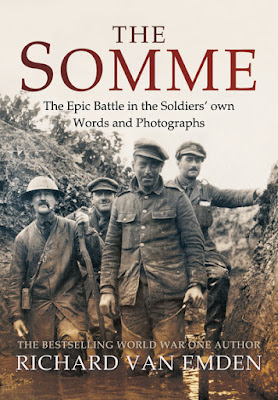
The Somme - The Epic Battle in the Soldiers' own words and photographs

http://www.pen-and-sword.co.uk/The-Somme-Hardback/p/11822

The Somme - The Epic Battle in the Soldiers' own Words and Photographs
Pen & Sword, £20

There are a number of reasons why this book should earn a place on military bookshelves. Although the Battle of the Somme took place nearly a century ago, and although it has been written about and debated ever since, in many respects this is a completely new take on that grim campaign. As Richard van Emden notes in his introduction, the scale of the tragedy on the first day alone - 60,000 casualties, including nearly 20,000 dead - has been repeated so many times that it has almost lost its power to shock. Instead, what we have here in this new appraisal, is a slow building up towards that dreadful day and the months that followed. The story begins not with the whys and wherefores of the campaign – these can be found easily enough in other books – but soldiers arriving on the Somme in July 1915 and Second Lieutenant George Webb of the 1st Dorsetshire Regiment writing of “a delightful little village some way east of Amiens.”

Richard Van Emden is a skilful and passionate author who has written many volumes on the First World War. Here though, he never lets that passion interfere with the voices of the men. This is, after all, “the epic battle in the soldiers’ own words…” and it is the men who tell the story, with Richard Van Emden coordinating in the background rather than intruding.

Many of the voices will be familiar to those of us who have studied the campaign over decades, and have built up our own libraries, but there are plenty of private papers which are published here for the first time and which provide fresh perspectives on a well-worn subject. I met and interviewed Sapper Norman Skelton, one of two people to whom this book is dedicated, back in the mid-eighties, and it is good to see him recalled in this volume, even though he was too young to have taken part in the 1916 campaign himself.

But this book is also far more than simply recollections. Personal photographs, many of these published for the first time, proliferate on these pages and show the unvarnished truth of life in the front line. These are not the official photographs, re-published many times over the last 100 years, but the amateur snapshots taken on hand-held Kodaks which have never been seen before.

The Somme is compelling, the soldiers’ words and photographs haunting. Get yourself a copy.

I also offer a comprehensive, fast and cost-effective military history research service. Follow the link for more information. 

Monday, 21 March 2016

Up the Micks! - Irish Guards illustrated


Published by Pen & Sword at £35, Up The Micks! is a superb pictorial history of the Irish Guards which begins with the regiment's formation in 1900 and brings the reader right up to the present day. I would have liked to have seen sources cited on more of the illustrations and photos, and it is unfortunate that the date of the regiment's first presentation of the colours is given as May 2002 rather than May 1902. However, these are minor quibbles and there is much to recommend this book, including useful appendices that detail everything over the years from gallantry awards and the evolving Colours to names of colonels and senior NCOs. This will be a very distracting coffee-table book as well as a quick and easy source of reference. I've only just started dipping into my copy but it's going to sit very comfortably with my other Guards regimental histories and I know it's going to be useful. Grenadiers, Coldstreams and Scots, take note.

I also offer a comprehensive, fast and cost-effective military history research service. Follow the link for more information.