Friday, 11 January 2013

The role of the cavalry defined


According to Punch, a General inspecting the officers of a cavalry regiment... asked a subaltern, "Now, sir, will you please tell me the role of cavalry in war." The subaltern replied: "Well, I suppose to give tone to what would otherwise be a mere vulgar brawl."

Quoted by General Sir H Hudson in History of the 19th King George's Own Lancers, 1937 and re-printed in the Marquis of Anglesey's A History of the British Cavalry 1816-1919, volume III.

Image courtesy of Wikipedia.

Thursday, 10 January 2013

Soldiers' Policies - Norwich Union


Spotted this advertisement in the Army List for 1909.  I wonder how many polices were actually taken out and how many were paid out.  Was this policy still an option from 1914?  I'm guessing it probably wasn't.

Wednesday, 9 January 2013

Army Returns 1871-1876

Some very useful stats here for the European Army of India and the Native Army between 1871 and 1876.  Saving the material is not an easy matter, and saving the images doesn't really work because they pixelate too much when you try to enlarge.  My tip would be to download the relevant page/s as a webpage text file and then copy the information into Word or Excel.

Tuesday, 8 January 2013

A soldier's change of heart

From Hansard

ARMY DISCHARGES AND REENLISTMENTS.

HC Deb 20 February 1893 vol 8 cc1860-1
MR. E. H. BAYLEY(Camberwell, N.)
I beg to ask the Secretary of State for War whether his attention has been called to the case of Susan Bennett, a widow, who spent her entire means in purchasing her son's discharge from the Army in April last, and the fact that, although the man re-enlisted within a month, the War Office refuses to refund any portion of the money; and whether there is any Regulation against the repayment; and, if so, whether he will abolish such Regulation, and in the meantime exercise the power he possesses to suspend it in the case of Susan Bennett?
*MR. CAMPBELL-BANNERMAN
I have no power, under existing Regulations, to make any refund of purchase-money in case of a man who re-enlists. The discharge and re-enlistment give rise to public charges from which the soldier should certainly not be relieved; but the subject generally is under consideration, and it is possible that some modification may be made in the present Rides.

Sunday, 6 January 2013

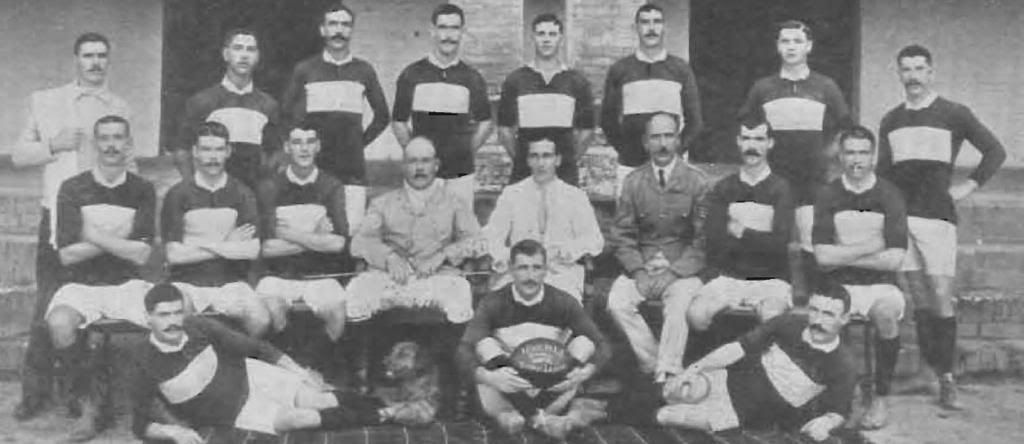
1st Bn HLI - I Coy Football Team - India 1909


Not the best quality photo in the world, but better than nothing I suppose, particularly if your ancestor happens to be one of the men captured above, and listed below:


This photo of the I Company football team was published on page 21 of the January 1910 issue (Volume X, No 1) of the Highland Light Infantry Chronicle, and many of the men pictured here would go on to serve with the Battalion during WW1. I've not researched all of the names here but Lt Alston was Captain Alston by 1915 and was killed in action at Chateau Redoubt near Neuve Chapelle on the 18th August that year. 5337 Col-Sgt Robert Brisbane, a prisoner of war by April 1915, survived the war as Warrant Officer Class II (and with a silver war badge to accompany his QSA, Delhi Durbar Medal 1911 and 1914 Star trio).

The names of the squad are:

Pte Smith, Pte Corrigan, Pte Docherty, Pte Schwerin, Pte McGeechan, Pte Wiseman, L/Cpl Lawson, Pte Passfield, Pte Reddy, L/Cpl Geake, Captain H T C Singleton DSO, Lt R C W Alston, Col-Sgt Brisbane, Pte Metcalfe, Pte Turner, Pte Olden, Pte Henderson, Pte Bruce.

Saturday, 5 January 2013

11538 Private A H Ball - a re-constructed service history


The Highland Light Infantry Chronicle, in its October 1919 issue, reports an undisposed of balance of £119 7s and 11d for a Private A H Ball; a considerable sum for a man drawing a shilling a day.  So how did a private soldier amass such a large amount?

My first step was to see when he died.  Soldiers Died in The Great War shows that he was Arthur Henry Ball, that his number was 11538 and that he "died" on the 18th July 1918.  "Died" is significant in that it implies he was neither killed in action nor died of wounds.  I checked the Commonwealth War Graves site and this shows that Private Ball was 24 years old at the time of his death and his buried in Berlin South-West Cemetery.  Dying in Germany, obviously suggests that he was a prisoner of war and again, the Highland Light Infantry Chronicle notes in its January 1915 issue that Private Ball is missing.

My own database of regimental numbers suggests that Arthur Ball joined the HLI in April 1910 and the HLI Chronicle supports this.  Arthur is noted as one of a party of 21 recruits who proceeded from the regimental Depot on 20th June 1910 to join the 2nd Battalion in Cork. He subsequently obtained a 2nd Class Army Certificate and on the 9th October 1912, was drafted to the 1st Battalion which was then stationed in India.

Arthur's medal index card shows that he arrived in France on the 1st December 1914 and The Long, Long Trail website confirms that on this date the 1st Battalion landed in Marseilles having travelled from Ambala in India, via Egypt.  That Arthur appears as missing in the January issue of the HLI Chronicle obviously suggests that he was captured soon after arriving in France.  As for his undisposed balance, I suggest that this was back pay accumulated during nearly four years' captivity in Germany. 

Finally, a word about Arthur Ball's age.  As noted, CWGC records his age in 1918 as 24.  If he joined the regiment eight years earlier, this suggests that he was born in 1894 and therefore enlisted as a boy soldier aged 16.  I think this is unlikely.  The HLI Chronicle (fastidious in its reporting), makes no mention that Arthur was a 'Boy'.  Furthermore, it was not British Army policy (pre 1914 anyway) to send soldiers younger than 20 years of age overseas, and we know that Arthur sailed for India in 1912.  I could almost certainly resolve the age question by checking census returns (SDGW gives his place of birth as Bristol) but as yet I've not had time to pursue this line of investigation.

Wednesday, 5 December 2012

A very human-faced lion


Great to see more records from the War Office being rapidly added to Find My Past, and as I've mentioned somewhere else (and I'll be blowed if I can find exactly where), the Royal Coats of Arms are worthy of study in their own right.  The image above is taken from a discharge paper in WO 122 and dates to 1803.  If I didn't know better, I'd say that the lion has been modelled on a person.  Take a good look.  It's certainly doesn't appear to be an animal's face. Can anyone speculate as to the lion's identity?  Duke of Wellington perhaps?

Friday, 12 October 2012

Undertones of Worley


I have been re-reading Edmund Blunden's Undertones of War and was pleasantly surprised to find that pages from Edmund Blunden's minute book are available online at the First World War Digital Poetry Archive. These include photos of his much loved sergeant Frank Worley (above) as well as fellow officers and other personalities mentioned in his memoir.  This was a real find for me and I hope it may be for others too.

Frank Worley's service record does not survive but we know that he joined the 11th Royal Sussex on the 11th September 1914 (probably at Worthing) and that he was given the number SD/555.  His medal index card incorrectly records his name as WARLEY. Frank Worley was awarded the Distinguished Conduct Medal, his citation reading:


He was discharged due to wounds in December 1918, married in 1922 and died at Worthing in 1954 at the age of 63.  The register entry for his death records his name as Francis J (for Joseph) Worley.

Sunday, 23 September 2012

The British Army & The Indian Railway

A while ago, wearing another hat as a so-called "military expert" for Find My Past, I attempted to answer a query from Jean Field regarding her British Army ancestor who was apparently, at some point in time, serving concurrently with the Indian Railways.  Jean's original query and my response is here, on the Find My Past blog.

Last week, re-reading Old Soldier Sahib by Frank Richards, I came across this passage which explains how the arrangement worked.  Frank was a regular soldier serving in India at the turn of the last century with the 2nd Battalion, Royal Welsh Fusiliers and he later served with distinction throughout World War I, winning the DCM and the MM into the bargain. I wish I'd recalled this passage from Old Soldier Sahib when I originally replied to Jean.

"One railway company invited men of good character to go through a six months' course of railway training. The only men who were eligible for this course were those who had six or twelve months to serve before they became time-expired. If they went through this course they were away from the battalion for six months but drew their ration money and pay; the railway company found them lodgings and also paid them a rupee a day for the duration of the course.  At the end of it they had to pass an examination, but even if they passed it they could still please themselves whether they took a job on the railway or went back to the battalion. If they accepted a job they were transferred to the Army Reserve, in spite of having perhaps six months still to serve before they became time-expired.  They generally began work as passenger guards, and rose from that to something higher."

Sunday, 17 June 2012

The Regimental Missus

Chanced upon this whilst doing some research on the 1st Bradford Pals:


My curiosity whetted, I clicked onto the image:


Married to the regiment, indeed.