Saturday, 9 July 2016

New military releases on Findmypast


Findmypast has recently made some major changes to its military collection.

For a start, the two service record collections which were previously known as British Army Service Records 1760-1915 and British Army Service Records 1914-1920 have now been merged into a single collection called simply British Army Service Records. This is a great improvement a) because the British Army Service Records 1914-1920 collection contained records going back a good way before 1914 anyway, and b) because it is now possible to see men who have files in more than one WO category.

Furthermore, Findmypast has also added to its store of WO records. New releases launched at the same time include the following series:

WO 76 - Regimental records of officers' services 1775-1914
Information varies but usually contains brief details of service. I found this particularly useful when I was looking at officers who had served in the Scottish Rifles.

WO 339 - Officers' services, First World War, regular army and emergency reserve officers 
This series is presented on Findmypast as index-only. The transcripts were created from records and correspondence related to officers in the regular army and the emergency reserve during the First World War. These records have not yet been digitised but can be viewed in their original state at The National Archives, Kew, London.

WO 374 - Officers' services, First World War, personal files 
This is an index of men who served as officers in the British Army during the First World War. Original papers for these men can be viewed in their original state at The National Archives, Kew, London. 
  
WO 400 - The Household Cavalry 1801-1919 
The Household Cavalry comprised the 1st Life Guards, 2nd Life Guards and the Royal Horse Guards. During the First World War, a fourth regiment, The Household Battalion, was also raised, and this collection contains the service records of non-commissioned officers and men who served with all four regiments. 

Findmypast also has also indexed WO 363 and WO 364 more comprehensively than Ancestry, although you'll still need Ancestry for medal index cards, medal rolls, soldiers effects register and war diaries (if you can find what you are looking for on their perplexing index, I might add).

I say it again and again, but there probably has never been a better time to be a family (or military) historian - and next week will probably be better still. And to think I used to have to trek up to Kew thirty years ago. The youngsters today, they don't know they were born!

Saturday, 11 June 2016

1st Bedfordshire Regt - 2 Vols - Going, going...


Naval and Military Press have this two-volume history of the 1st Battalion, Bedfordshire Regiment up for sale at £12.99, discounted from £40.00. With postage, it will cost you £16.84 in total (I know that for a fact because I've just this minute ordered my own copies). 

Steve Fuller is something of an expert on the Beds Regt and so this book should do the battalion justice. I have a 1914 Star trio and LSGC to one of the Beds regulars and so this book will be useful now, and in the future. I would imagine these volumes will be hard to come by before very long so grab yourself the set whilst you still can.

Tuesday, 24 May 2016

The First Day of The Somme - Gommecourt to Maricourt - 1 July 1916


The First Day of the Somme, by seasoned authors and Western Front travellers Jon Cooksey and Jerry Murland, is not due for release until the 30th June but I know, having seen a proof copy, that it is going to be an indispensible companion to anyone with an interest in walking the Somme battlefields. As unwieldy as my proof copy is, I shall certainly make sure it is tucked into my rucksack when I head over for France myself in time for the 100th anniversary commemorations.

Eleven routes are covered in the book, the longest being the Gommecourt to Serre spine route at 5.3 miles, and the shortest being the Fricourt to Mametz route at just 1.5 miles. The determined traveller, blessed with good weather and sturdy walking boots could probably cover two or more of these walks in a single day, albeit these are not routes to be taken lightly, rather pilgrimages studded with cemeteries, private memorials, grassed-over craters and fading trench lines. On these walks, nearly 60,000 men spilled blood on the opening day of the battle itself, and tens of thousands would die before the campaign ground to a bloody and muddy halt in November 1916.

Each route begins with a general description and context and there are simple maps with key points indicated which the text then refers to.  For instance, the first route in the book, Gommecourt North, has nine points of interest indicated and so I can see that figure 1 refers to a plaque to the 1/5th North Staffordshire Regiment on the wall of the Mairie, figure 3 offers a view to le Bois Batard and figure 4 indicates the ground over which the 1/5th and 1/7th Sherwood Foresters of 139 Brigade advanced. The narrative never bores and is interspersed with accounts written or narrated by men who were there. Additional text and photographs pick out memorials, cemeteries, portraits of participants and the landscape itself. Emboldened text draws the reader's eye quickly to named individuals and places.

This is a GOOD book, and quite possibly a GREAT book. I suspect that it will be more useful on a Kindle than in book format, but nevertheless I'm going to grasp the bull by the horns and take my A4 proof copy secured in a plastic ring binder and pore over the pages as I tramp across the fields of northern France. Thankfully the book also notes places to rest and refresh and so that's covered too.

I can't comment on the book's look and feel but I suspect that, typical of Pen & Sword titles, this volume will be published to the usual high standard.

I also offer a comprehensive, fast and cost-effective military history research service. Follow the link for more information. 


Using local newspapers


As the 100th anniversary of the opening of the Battle of the Somme draws closer, and as more and more military records appear online, a reminder not to overlook the steadily growing British Newspaper Archive.

Since it was launched, over 16m pages from 696 publications have been digitised and published online.You can take out a subscription with the BNA or access the same material through Findmypast. I use the resource a lot and have always thought what a bargain it is to be included in the Findmypast subscription. Although the majority of the published pages date to the nineenth century, there is a growing collection of pages from the twentieth century, including many regional papers published during the First World War. It is these papers which can help to add so much more detail about a soldier, particularly if he was an officer and was killed in action.

For the purpose of this post,let's just take a look at a single page of The Liverpool Daily Post for the 21st July 1916.  Here, the newspaper has pulled names of officers from the official Times casualty lists and published details of Other Ranks from Liverpool and the surrounding areas.  There is good coverage of officer fatalities, which, in this particular issue, included a photograph of Captain Horace John Simkin and the following biography:

Captain Simkin was killed in action whilst serving with C Company, 13th King's (Liverpool Regiment) and is buried in Dive Copse British Cemetery at Sailly-le-Sec. The Commonwealth War Graves Commission entry notes that he had been mentioned in dispatches.

So ignore newspapers at your peril. Many include photographs of other ranks who were killed or died of wounds - The Manchester Evening News is a good example here - and don't give up just because the search term you have keyed in does not yield results. OCR is still - despite what others might say - an imperfect science and it does not always pick up the text accurately. If you know an ancestor became a casualty on a particular date, try and find the newspaper that would have covered the area where he was living and then start browsing the pages online. Having spent a fortnight at the British Newspaper Library in Colindale many years ago, trawling through back issues of various Sussex newspapers, I can assure you that the online searching is a good deal easier - and doesn't leave newsprint on your fingers.

I also offer a comprehensive, fast and cost-effective military history research service. Follow the link for more information. 


Sunday, 1 May 2016

The Old Contemptible


Does anybody have copies of this publication that they would be willing to sell? A complete set sought but will also consider loose copies. Drop me a line via the RESEARCH tab please.

I also offer a comprehensive, fast and cost-effective military history research service. Follow the link for more information. 

Thursday, 14 April 2016

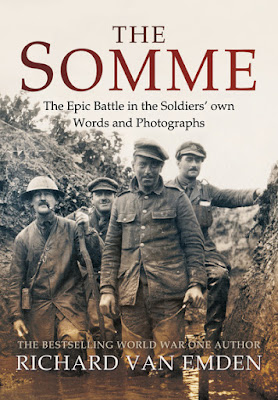
The Somme - The Epic Battle in the Soldiers' own words and photographs

http://www.pen-and-sword.co.uk/The-Somme-Hardback/p/11822

The Somme - The Epic Battle in the Soldiers' own Words and Photographs
Pen & Sword, £20

There are a number of reasons why this book should earn a place on military bookshelves. Although the Battle of the Somme took place nearly a century ago, and although it has been written about and debated ever since, in many respects this is a completely new take on that grim campaign. As Richard van Emden notes in his introduction, the scale of the tragedy on the first day alone - 60,000 casualties, including nearly 20,000 dead - has been repeated so many times that it has almost lost its power to shock. Instead, what we have here in this new appraisal, is a slow building up towards that dreadful day and the months that followed. The story begins not with the whys and wherefores of the campaign – these can be found easily enough in other books – but soldiers arriving on the Somme in July 1915 and Second Lieutenant George Webb of the 1st Dorsetshire Regiment writing of “a delightful little village some way east of Amiens.”

Richard Van Emden is a skilful and passionate author who has written many volumes on the First World War. Here though, he never lets that passion interfere with the voices of the men. This is, after all, “the epic battle in the soldiers’ own words…” and it is the men who tell the story, with Richard Van Emden coordinating in the background rather than intruding.

Many of the voices will be familiar to those of us who have studied the campaign over decades, and have built up our own libraries, but there are plenty of private papers which are published here for the first time and which provide fresh perspectives on a well-worn subject. I met and interviewed Sapper Norman Skelton, one of two people to whom this book is dedicated, back in the mid-eighties, and it is good to see him recalled in this volume, even though he was too young to have taken part in the 1916 campaign himself.

But this book is also far more than simply recollections. Personal photographs, many of these published for the first time, proliferate on these pages and show the unvarnished truth of life in the front line. These are not the official photographs, re-published many times over the last 100 years, but the amateur snapshots taken on hand-held Kodaks which have never been seen before.

The Somme is compelling, the soldiers’ words and photographs haunting. Get yourself a copy.

I also offer a comprehensive, fast and cost-effective military history research service. Follow the link for more information. 

Friday, 1 April 2016

Brighton & Norwich in The Great War

Pen & Sword's Towns and Cities in the Great War series has a lot to commend it, and I've just finished reading a couple of recent additions: Brighton in the Great War (Pen and Sword, £14.99) and Norwich in the Great War (Pen and Sword, £12.99).

Brighton in the Great War

At 266 pages, this is one of the better value books in this series. Of particular interest to me are the sections dealing with the military and auxiliary hospitals in the town. The vast majority of the men who found themselves transferred out to Chailey's two auxiliary hospitals had originally been treated at the 2nd Eastern General Hospital in Dyke Road. That hospital is well-covered in this book, as are many others, including the Kitchener Hospital and the Brighton Pavilion, transformed as a hospital to treat Indian troops. The author must have spent many hours on this particular research project and has mad good use of contemporary reports published in local newspapers and elsewhere. This is an easy and compelling read.

Norwich in the Great War

This volume, slightly cheaper than the Brighton in The Great War, also has a 50 per cent lower page count. That's a shame because Norwich was an important hub in this part of England and I would have thought that there would have been plenty more relevant information that could have usefully been published here. The Norfolk Regiment, for instance, is barely touched upon, and yet the city of Norwich provided two companies for the 4th Battalion (Territorial Force), and one battalion for the 6th (Cyclist) Battalion (TF). The Norfolk Yeomanry was also headquartered in the city, and Norwich provided one of the regiment's four squadrons. None of these men have a voice in this book. The author also asserts that the Norfolk Regiment's nickname, "Holy Boys", owes its origins to the city of Norwich having many churches. More colourful - and, I have to say, plausible - origins of the nickname which the author might have added are that it was gained when a) the men sold their bibles during the Peninsula Wars to buy drink or b) Spanish soldiers mistook the figure of Britannia on the men's badges for the Virgin Mary.

Local effort in the Great War

I have several of the books in Pen and Sword's Towns and Cities series but it is really pot luck as to whether the author has gone the extra mile to really get under the skin of the place during the Great War. Douglas D'Enno has done so for Brighton, Stephen Browning could have done more for Norwich. Having said that, both books - and books in the series in general - are full of evocative photos, many published in book format for the first time, and there are plenty of snippets of information which help to paint a picture of the time. Were I living in Brighton or Norwich with only a passing interest in local history I would still consider both books essential additions to my library. I just might feel I'd got better value if I lived in Brighton.

I also offer a comprehensive, fast and cost-effective military history research service. Follow the link for more information. 

Wednesday, 30 March 2016

Was your Great War ancestor a footballer?

There are some very impressive First World War commemoration sites on the web and I was advised about this one by the author a little while back

Football and the First World War is, "a searchable database containing the military service records of all Football League, Southern League and Scottish Football League players who served in the armed forces during World War One." There are around 500 profiles that have already been published, and more will follow in due course.

The man behind the site, Iain McMullen, is to be congratulated both for his research and also for constructing a very user-friendly and attractive-looking site. I have borrowed one of Iain's images, that of Arthur Richard Kempton of Arsenal, to illustrate this post.

I also offer a comprehensive, fast and cost-effective military history research service. Follow the link for more information. 

Monday, 21 March 2016

Up the Micks! - Irish Guards illustrated


Published by Pen & Sword at £35, Up The Micks! is a superb pictorial history of the Irish Guards which begins with the regiment's formation in 1900 and brings the reader right up to the present day. I would have liked to have seen sources cited on more of the illustrations and photos, and it is unfortunate that the date of the regiment's first presentation of the colours is given as May 2002 rather than May 1902. However, these are minor quibbles and there is much to recommend this book, including useful appendices that detail everything over the years from gallantry awards and the evolving Colours to names of colonels and senior NCOs. This will be a very distracting coffee-table book as well as a quick and easy source of reference. I've only just started dipping into my copy but it's going to sit very comfortably with my other Guards regimental histories and I know it's going to be useful. Grenadiers, Coldstreams and Scots, take note.

I also offer a comprehensive, fast and cost-effective military history research service. Follow the link for more information. 

Sunday, 13 March 2016

The Thuillier Collection - WW1 photographic archive


I came across this archive completely by chance, this morning. It's not a new story by any means but it was news to me and so I thought I'd flag it here.

As the story goes, the so-called Thuillier Collection comprises around 3,000 glass plate negatives of British, Indian, French, Australian and American troops, and even some members of the Chinese Labour Corps. For some unaccountable reason the collection, having lain undisturbed in a Somme barn for close on a hundred years, seems to have been broken up, Australia's Channel 7 having acquired 500 of the plates which depict Australian troops.

Named after the photographers, local farmer Louis Thuillier and his wife Antoinette, I'm sure there must be more reference to The Thuillier Collection online which a basic Google search would uncover. There are certainly some images on this Sunday Night page, all of which can be downloaded with a quick right click and save of the mouse.

I also offer a comprehensive, fast and cost-effective military history research service. Follow the link for more information.